
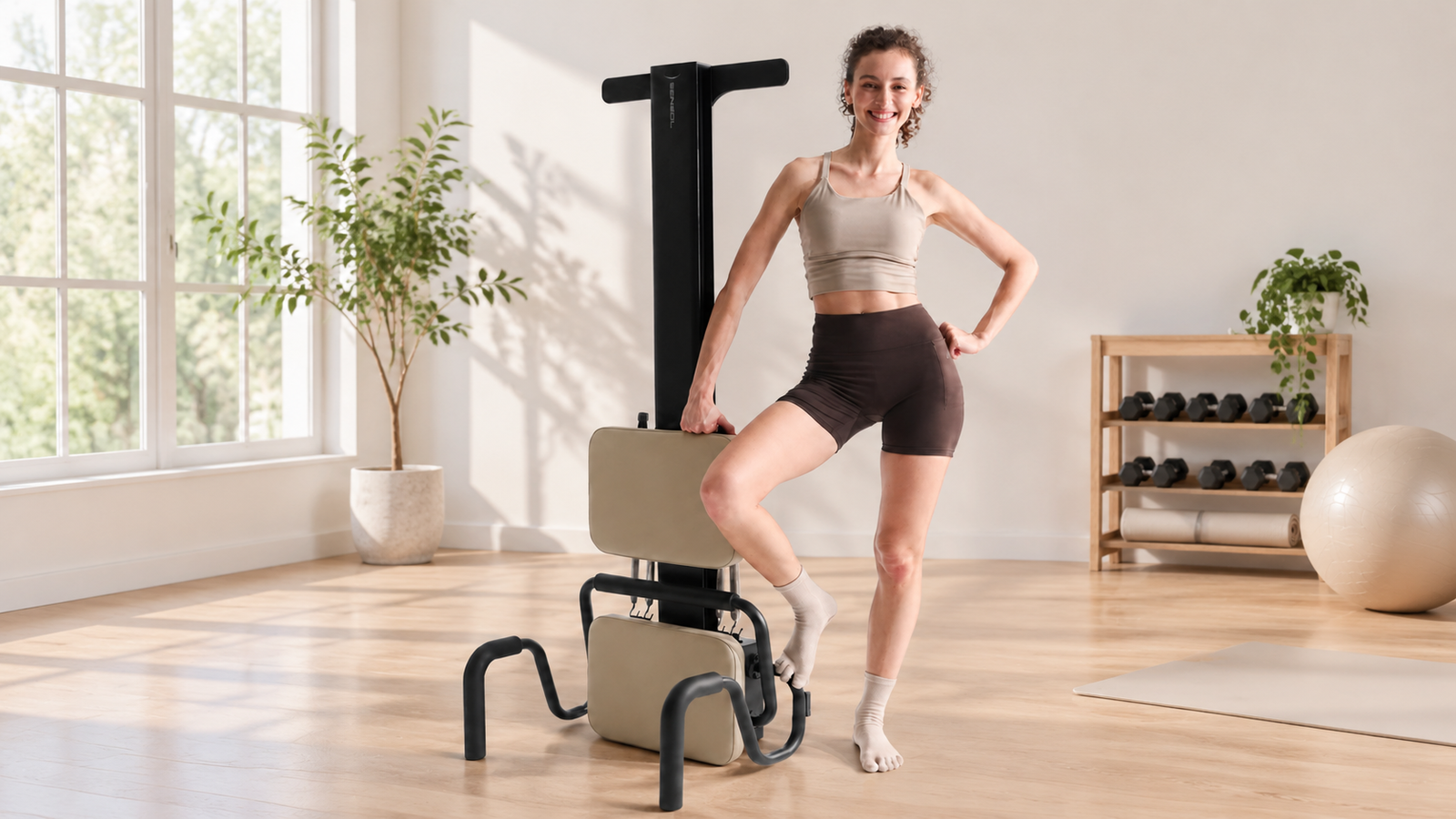
FLEX AIR makes home Pilates practical when space is planned well
Is the Sensol FLEX AIR worth it for home use? It can be a practical choice for beginners who want a compact, spring-resistance Pilates reformer, have enough room for its 64.8 × 24.3 × 17.3 in setup dimensions and will use its upright storage position between sessions. It is less suitable for anyone who needs a machine for users above 264.6 lb, expects a fully assembled room-of-choice delivery or cannot leave clear movement space around the reformer.
The FLEX AIR costs $699.00 and is designed to bring controlled Pilates movement into an everyday home routine. Its mechanical springs provide the reformer’s main resistance, while two handles, one ankle strap and four complimentary elastic bands are included. The bands are intended for separate accessory exercises, so they should not be confused with the machine’s primary resistance system.
That distinction matters for a beginner. This is not simply an exercise platform paired with loose bands; it is a mechanical reformer built around spring resistance. The useful question is therefore not whether it can disappear into a tiny corner while in use, but whether its combination of working footprint, upright storage and guided workouts fits the way you intend to train.
The listed footprint is only the starting point for a safe setup
When set up, FLEX AIR measures 64.8 in long, 24.3 in wide and 17.3 in high, equivalent to 164.5 × 61.6 × 43.9 cm. Those measurements help determine whether the reformer itself fits, but they do not describe the total workout area. Sensol specifically advises allowing clear space around the machine for your full range of movement.
Before ordering, mark the reformer’s dimensions on the floor where you plan to train. Then consider where your arms, legs and accessories will travel during a session. A location that accommodates the frame but blocks movement with a wall, desk or sofa is not a workable Pilates area.
The upright storage position is useful because it lets you reclaim floor space between sessions. It does not remove the need for a suitable training zone, and storage should follow the supplied instructions. A realistic plan accounts for both states: where the reformer stands while stored and where it will sit with open space around it during exercise.
This sort of advance planning supports healthy home habits because it reduces the number of decisions required before each session. Resources focused on practical everyday wellness and joint-friendly fitness similarly frame health around workable habits rather than dramatic short-term changes.
Mechanical springs define how FLEX AIR delivers resistance
The springs are the main training system
FLEX AIR uses mechanical springs as its primary source of resistance for Pilates training. That is the central mechanism to understand when comparing it with products that rely mainly on elastic bands. Beginners should use the machine according to the supplied setup and safety instructions rather than assuming every resistance system operates in the same way.
The included bands serve a separate purpose
Four elastic bands are supplied as a complimentary gift for separate accessory exercises. They are not the reformer’s main resistance system. Keeping those roles clear makes the package easier to assess: the reformer provides spring resistance, while the bands add a separate accessory option.
The user limit is part of equipment selection
The stated maximum user weight is 264.6 lb, or 120 kg. Anyone above that limit should not select FLEX AIR on the basis of the provided specifications. Weight capacity is a basic compatibility requirement, not a target to reinterpret or estimate around.
The available product facts do not state frame, carriage or upholstery materials, and they do not provide resistance ranges or laboratory test results. A careful buyer should not infer those details from photographs or general claims about Pilates equipment. For this model, a fact-based comparison should stay with the published spring mechanism, dimensions, weight limit, included accessories, storage position and delivery terms.
A repeatable beginner routine matters more than an ambitious schedule
FLEX AIR includes SENSOL FLEX workout guidance to help users build a routine. For a first session, the sensible starting point is to follow that guidance, confirm the setup and keep movement controlled. There is no need to create an elaborate program before becoming familiar with the supplied instructions and the reformer’s spring-based operation.
A practical routine begins before the exercise itself. Clear the required floor area, set up the reformer as directed and keep the handles, ankle strap and any accessory bands organized. After training, follow the storage instructions before placing the reformer upright. These simple steps make the equipment easier to integrate into wellness at home without treating setup as an afterthought.
Frequency should match the workout guidance available to you and your personal circumstances; the supplied product information does not prescribe a universal weekly schedule. Beginner-focused wellness resources also tend to emphasize realistic daily changes. For example, The Lifeology’s guide connects diet, fitness and mindset through manageable habits, while the Cleveland Clinic discusses integrating healthy habits into daily life.
Consistency does not require every session to look identical. What matters here is having a repeatable process for preparing the space, using the reformer as instructed and putting it away correctly. That structure is more useful than setting a demanding schedule that does not fit your home or routine.
Home Pilates works best as one part of a broader routine
A reformer can provide a defined place for controlled movement, but simple healthy living is broader than one piece of equipment. Sleep, food, daily activity and a sustainable mindset still shape an overall routine. FLEX AIR’s role is specific: it gives you a compact spring-resistance reformer that can be set up at home and stored upright afterward.
For many people, the practical advantage of home equipment is reducing the transition between deciding to train and beginning a session. That advantage only lasts when the surrounding area remains usable and the equipment is treated properly. Keeping the workout zone clear and the accessories together are modest healthy home habits, but they can make regular practice less cumbersome.
A useful reference point is the Healthy Living Guide’s focus on simple, sustainable lifestyle changes. Applied here, sustainability means choosing a routine that fits the available room, respecting the 264.6 lb maximum user weight and following the supplied setup, storage and safety instructions every time.
FLEX AIR is not the right reformer for every home or user
Do not choose FLEX AIR if the intended user exceeds its 264.6 lb maximum user weight. It is also a poor fit when the room cannot accommodate both the 64.8 × 24.3 × 17.3 in machine and additional clear space for full movement. Upright storage helps between sessions, but it does not make an undersized exercise area suitable.
This model may also disappoint buyers who expect the complimentary elastic bands to power the reformer, since its main resistance comes from mechanical springs. Likewise, it is not a match for someone who requires inside delivery, stair carry, room-of-choice placement or assembly as part of standard shipping; those services are not included.
Delivery coverage requires attention as well. Free standard curbside freight delivery applies to eligible addresses in the contiguous 48 U.S. states, with liftgate unloading included where required. Offshore islands and U.S. island territories, including Hawaii and Puerto Rico, are excluded, remote serviceable mainland addresses may incur a carrier surcharge, and customers should verify service to a specific Alaska mainland address before ordering.
Where to Buy
For United States customers: Sensol FLEX AIR at the official Sensol store — US store
FAQ
How do I choose quality on a budget?
Compare the facts that affect actual use: the primary resistance mechanism, setup dimensions, user weight limit, included accessories, storage method and delivery terms. At $699.00, FLEX AIR provides mechanical spring resistance, two handles, one ankle strap and four complimentary bands, but the supplied information does not specify materials or resistance ranges, so do not invent those factors when comparing value.
What mistakes should I avoid?
Do not mistake the four gift bands for the reformer’s main resistance system, ignore the 264.6 lb user limit or treat the listed dimensions as the complete workout area. Another avoidable mistake is moving directly into a session without following the supplied setup, storage and safety instructions.
How often should this be refreshed or maintained?
No maintenance interval is stated in the provided product information, so a specific schedule would be guesswork. Follow the supplied safety and storage instructions, and obtain current maintenance guidance directly from Sensol when needed rather than applying an unsupported timetable.
What should beginners start with?
Start with the supplied SENSOL FLEX workout guidance and focus on controlled movement. Before training, confirm that the reformer is set up as instructed, that there is clear space beyond its 64.8 × 24.3 in floor footprint and that you understand the separate roles of the mechanical springs and accessory bands.
The space-planning tips for home Pilates were really helpful, especially the reminder to check the FLEX AIR’s full setup dimensions before buying.
The space-planning tips for home Pilates were really useful, especially the reminder to check the FLEX AIR’s full setup dimensions before buying. Upright storage sounds handy for a smaller workout area.