
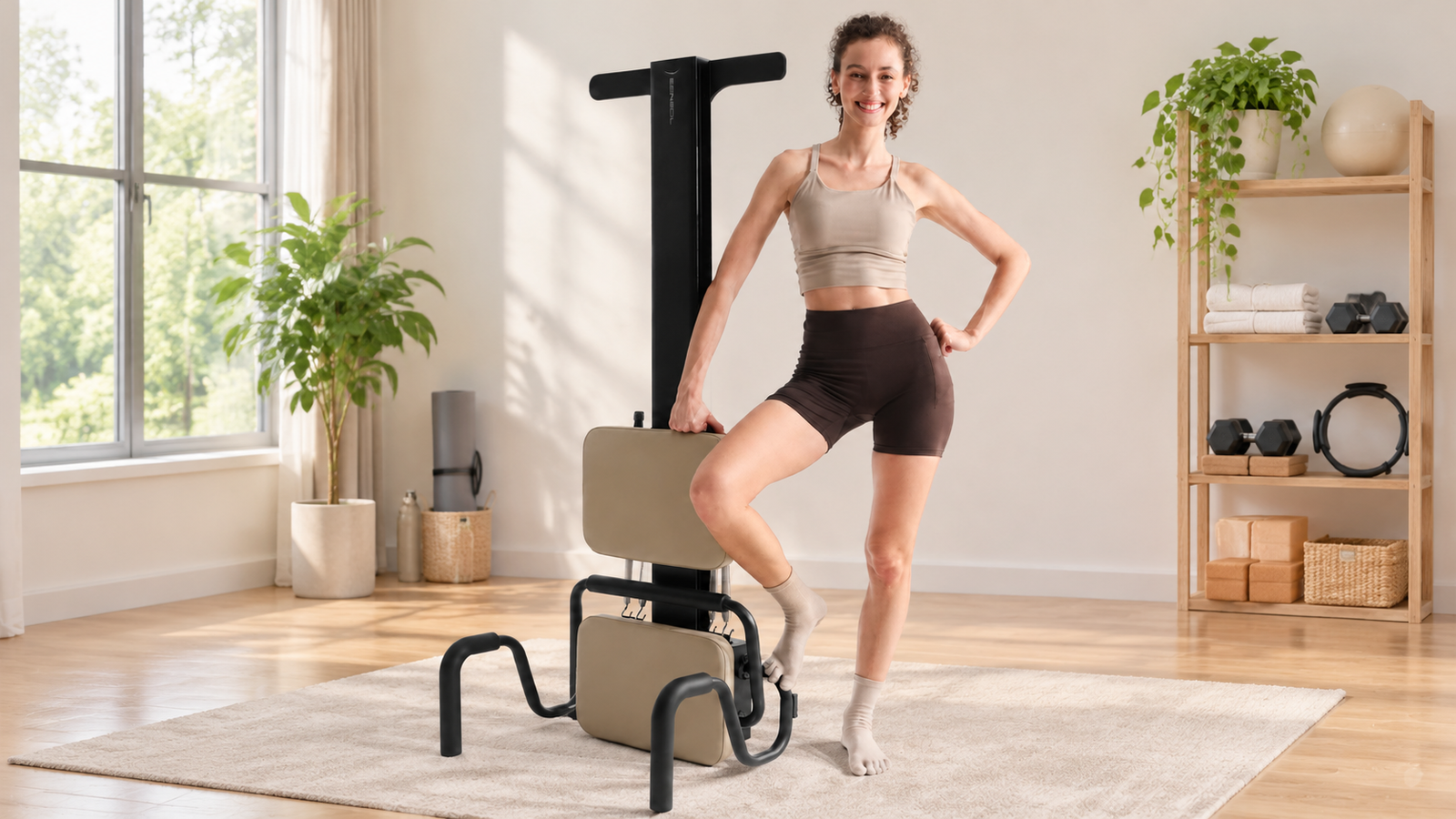
The FLEX AIR makes reformer Pilates more workable in a small home
The Sensol FLEX AIR is a compact Pilates reformer designed around a familiar apartment problem: you may have enough room to exercise, but not enough room to leave large equipment in place all day. Its setup dimensions are 64.8 × 24.3 × 17.3 inches (164.5 × 61.6 × 43.9 cm), and it can be placed upright for storage between sessions. That combination makes it relevant to renters, apartment residents, and anyone building a practical wellness at home routine in a multipurpose room.
Is the Sensol FLEX AIR worth it for home use? It can be worth considering if you want a spring-resistance Pilates reformer, have room for its full setup footprint plus movement clearance, and will use its upright storage position between workouts. It is less suitable if you cannot provide a clear exercise area, exceed the 264.6-pound (120 kg) user limit, or need delivery services such as assembly or room-of-choice placement.
The listed US price is $699.00. That number is most useful when judged against how the machine would fit your actual routine rather than against an imagined home studio. A compact reformer still needs deliberate space planning, regular setup, and a place where upright storage will not obstruct daily life.
Measuring the full movement zone matters more than measuring the machine alone
Start with the 64.8 × 24.3-inch equipment footprint
The reformer itself measures 64.8 inches long and 24.3 inches wide when set up, with a listed height of 17.3 inches. Mark those dimensions on the floor before ordering. Painter’s tape can show whether the reformer would conflict with a sofa, dining chair, opening door, radiator, or the route people use through the room.
Do not treat that taped rectangle as the complete workout area. Sensol specifically instructs users to allow clear space around the reformer for their full range of movement, and the listed product dimensions are not the total exercise zone. Arms, legs, handles, and accessory movements may extend beyond the frame, so test the surrounding area by moving through the positions you expect to use.
Choose the storage position before choosing the workout position
Upright storage lets you reclaim floor space after training, which is the FLEX AIR’s most apartment-relevant feature. Even so, the storage location should be chosen according to the supplied setup, storage, and safety instructions. A practical location also needs to stay clear of doors, walkways, and anything that would make putting the reformer away inconvenient.
This planning step supports healthy home habits because it removes a common source of friction. If setting up requires rearranging several heavy pieces of furniture, a short session becomes a household project. A clear training zone and a predetermined storage spot make the routine easier to repeat without turning the room permanently into a gym.
Mechanical springs define the workout, while the gift bands stay separate
The reformer’s main resistance comes from springs
The FLEX AIR is a mechanical reformer, and mechanical springs provide its main resistance for Pilates training. This distinction matters when comparing compact equipment: the four included elastic bands are not the reformer’s resistance system. They are complimentary accessories intended for separate exercises.
Spring resistance and controlled movement place the focus on how deliberately you perform a session. Beginners should follow the supplied setup and safety instructions and use the available SENSOL FLEX workout guidance to build familiarity with the equipment. The product facts do not specify spring settings or prescribe a training level, so users should avoid assuming that a particular configuration is appropriate without consulting that guidance.
The included accessories support more than one type of session
The package includes the FLEX AIR reformer, two handles, one ankle strap, and four elastic bands. Keeping the bands conceptually separate from the reformer is useful when planning an apartment routine: a reformer session uses the machine’s mechanical springs, while an accessory session with the gift bands can be organized independently.
That separation can also keep a small exercise area orderly. Store the handles, ankle strap, and bands together so that loose accessories do not spread through the room. The goal is not to accumulate more equipment; it is to make the provided components easy to locate, inspect, and return after use.
A repeatable room routine makes compact equipment easier to use
A realistic apartment session starts before the exercise itself. Clear the movement zone, place the reformer according to the supplied instructions, check that the surrounding floor remains unobstructed, and gather only the accessories needed for that session. Afterward, return the accessories and move the reformer into its upright storage position as directed.
This simple sequence fits a broader approach to simple healthy living: reduce the number of decisions required each time. The Wellness Society’s collection of at-home self-care practice ideas discusses making space for personal care amid work, family, and daily tasks. For reformer practice, that means choosing a schedule and room arrangement that can survive an ordinary week, not just an unusually quiet day.
Consistency does not require every session to look identical. A longer reformer workout may suit a weekend, while a separate accessory exercise with the complimentary bands may fit another day. The important factual boundary is that those bands do not replace the FLEX AIR’s spring-resistance mechanism.
If you prefer a more structured reset, Ashlina Kaposta’s step-by-step guide to an at-home wellness retreat offers an hour-by-hour framework for combining home-based activities. Pilates can occupy one planned block within that kind of day without requiring the reformer to dominate the room afterward.
Small environmental choices help Pilates become a healthy home habit
The room should support attention and safe movement rather than imitate a commercial studio. Keep the floor area clear, put frequently used accessories in one predictable place, and avoid locating the reformer where someone must pass through the movement zone. These choices are modest, but they make wellness at home easier to integrate with cooking, working, and relaxing in the same limited space.
A routine is also more sustainable when it includes transitions. Allow time to set up according to the instructions instead of rushing directly into movement, then reserve a few minutes to put everything away. The Kuel Life guide to a wellness routine at home focuses on simple rituals, calming spaces, and repeatable habits, all of which are relevant when one room serves several purposes.
For beginners who want to build a broader practice gradually, the Home Wellness Practice Starter Guide for Beginners discusses establishing daily habits at home. The useful takeaway for apartment Pilates is to start with a routine you can maintain. Owning a reformer does not remove the need to schedule sessions, preserve a clear area, and follow the equipment guidance.
The FLEX AIR’s 264.6-pound (120 kg) maximum user weight is another non-negotiable planning factor. Anyone above that limit should not use this model. For households with multiple prospective users, confirm that every person falls within the stated limit and understands the setup, storage, and safety instructions.
The FLEX AIR is not right for every apartment or every user
This reformer is not suitable for someone who lacks a clear area larger than the listed machine footprint. Although upright storage reclaims floor space between sessions, it does not reduce the room needed while exercising. A very narrow bedroom, a congested living room, or any location where movement crosses a busy walkway may not provide a workable training zone.
It is also not for users above the maximum weight of 264.6 pounds (120 kg). People looking specifically for an elastic-band reformer should note that FLEX AIR’s main resistance comes from mechanical springs; the four elastic bands are complimentary gifts for separate accessory exercises. That difference should be understood before purchase.
Delivery expectations can be another limitation. For eligible addresses in the contiguous 48 U.S. states, Sensol states that free standard curbside freight delivery and liftgate unloading where required are included. Inside delivery, stair carry, room-of-choice placement, and assembly are not included. The company does not deliver to offshore islands or U.S. island territories, including Hawaii and Puerto Rico, while remote serviceable mainland addresses may incur a carrier surcharge confirmed in advance. Customers should contact Sensol before ordering to verify service to a specific Alaska mainland address.
Finally, compact does not mean maintenance-free or instruction-free. Buyers who do not want to manage setup, storage, safety checks, and a clear exercise area should reconsider whether any home reformer suits their space. The FLEX AIR is most coherent for someone willing to make those actions part of the routine.
Where to Buy
Sensol FLEX AIR at the official Sensol store — US store
Frequently asked questions for a practical apartment setup
What should beginners start with?
Beginners should start by reading and following the supplied setup, storage, and safety instructions, then use the SENSOL FLEX workout guidance to build a routine. Before the first session, measure the 64.8 × 24.3-inch setup footprint and leave additional clear space for full movement.
How do I choose quality on a budget?
Compare equipment using confirmed facts that affect your home: the resistance mechanism, setup footprint, maximum user weight, included accessories, storage method, delivery terms, and current warranty and returns information. For the $699.00 FLEX AIR, that means mechanical spring resistance, upright storage, a 264.6-pound user limit, two handles, one ankle strap, and four gift bands for separate accessory exercises.
What mistakes should I avoid?
Do not confuse the machine dimensions with the total workout area, and do not treat the complimentary elastic bands as the reformer’s main resistance system. Avoid placing the reformer in a walkway, exceeding the stated user-weight limit, or assuming curbside freight includes stair carry, indoor placement, or assembly.
How often should this be refreshed or maintained?
No maintenance interval is provided in the available product facts, so follow the supplied instructions rather than inventing a schedule. Refresh the practical setup whenever furniture changes, a new household member begins using the reformer, or the designated movement and storage areas no longer remain clear.
The Sensol FLEX AIR sounds like a practical option for apartment Pilates, especially if it’s easy to store between workouts. I’d be curious to know how sturdy it feels compared with a full-size reformer.