
A 30-day plan makes home Pilates easier to sustain
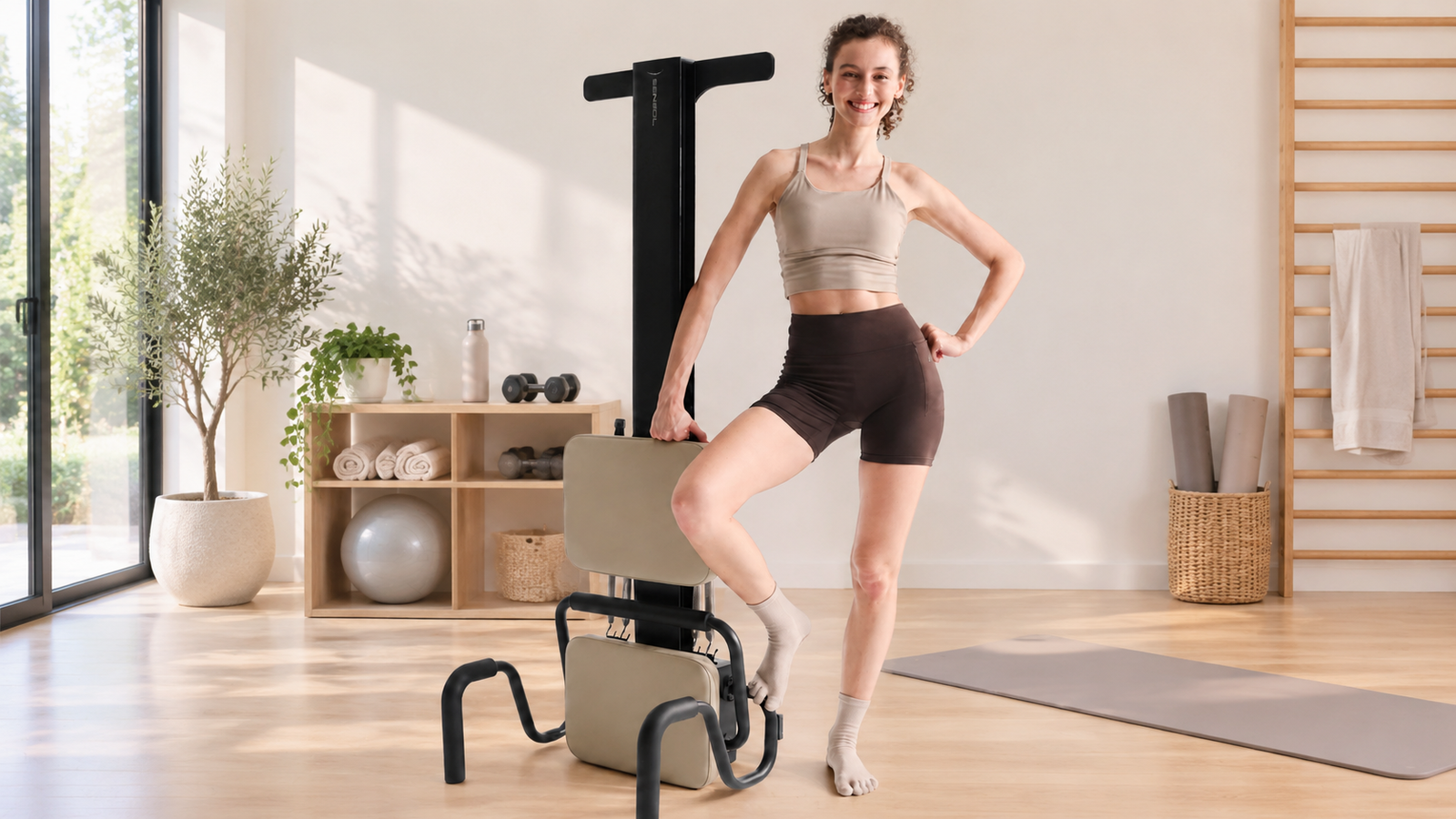
The Sensol FLEX AIR is a compact Pilates reformer designed for controlled home training. Its main resistance comes from mechanical springs, while its upright storage position helps return floor space to everyday use after a session. After using it as part of a home routine, I found that this relationship between training and storage matters as much as the exercise plan itself: the machine needs a defined place to work and a sensible place to wait.
Is the Sensol FLEX AIR worth it for home use? It can be worth considering if you want a compact, spring-resistance reformer, have room for its 64.8 × 24.3 × 17.3 in (164.5 × 61.6 × 43.9 cm) set-up dimensions and value upright storage between sessions. It is not the right choice if you exceed its 264.6 lb (120 kg) maximum user weight or cannot provide clear space around it for full movement.
This beginner plan runs for 30 days, but it does not ask you to train hard every day. Instead, it builds healthy home habits through short practice sessions, recovery days and regular space checks. That approach fits a broader idea of wellness at home: Everyday Health describes a healthy home as a safe, clean and peaceful setting that supports lifestyle choices, not merely a place filled with wellness products.
A measured setup gives every session a safer starting point
Before day one, measure the intended training area rather than relying on the reformer dimensions alone. FLEX AIR measures 64.8 × 24.3 × 17.3 in when set up, equivalent to 164.5 × 61.6 × 43.9 cm. Those figures describe the product, not the total workout zone, so allow additional clear space for your full range of movement.
This distinction is especially important in an apartment, spare room or shared Australian living area. A reformer may fit within the room on paper while leaving too little usable space beside it. Move loose objects out of reach, follow the supplied setup and safety instructions, and confirm that the storage position will not obstruct normal household movement.
Give the reformer a repeatable home base
Choose one training location and use it consistently during the 30 days. Repeatedly clearing the same area is simpler than improvising a new location each session, and it makes the reformer part of a routine rather than a temporary obstacle. The FLEX AIR can then be placed in its upright storage position when you need to reclaim the floor.
Keep the surrounding room practical
Simple healthy living depends partly on reducing avoidable friction. Keep the workout area clean and check that items have not migrated into the movement zone before each session. For room-by-room cleaning ideas, Healthline provides guidance for cleaning kitchens, bathrooms, bedrooms and the wider home.
Understand the two resistance tools
The reformer’s primary resistance system is mechanical springs. FLEX AIR also includes four elastic bands as a complimentary gift, but these are intended for separate accessory exercises and are not the reformer’s main resistance source. Also included are two handles and one ankle strap; use each item only in line with the supplied guidance rather than assuming the bands replace or modify the spring system.
Days 1–7 establish control before adding volume
The first week is about familiarity. Complete three brief reformer sessions on non-consecutive days, using the SENSOL FLEX workout guidance to select beginner-appropriate movements. Spend the first session learning the setup process and moving slowly enough to notice whether you can maintain control throughout each guided pattern.
On the days between reformer sessions, leave room for rest or gentle movement away from the machine. The aim is not to accumulate the highest possible session count. It is to create a repeatable sequence: clear the area, complete the supplied setup checks, practise controlled movement, finish calmly and store the reformer according to its instructions.
Use consistency as the first measure of progress
For days 1, 3 and 5, keep the session short enough that technique remains your priority. Avoid chasing speed or trying to make the mechanical spring resistance feel unnecessarily difficult. On day 7, review whether the schedule, room and storage process worked in real life.
Small actions are more useful here than an elaborate lifestyle overhaul. A guide to healthy home habits from Just Simply Mom similarly frames comfortable routines as the result of small, consistent actions rather than complicated systems. That principle applies neatly to a first week on a reformer.
Days 8–21 add practice without sacrificing technique
During the second and third weeks, move to three or four reformer sessions per week if the first week felt manageable. Continue following the SENSOL FLEX workout guidance, and add practice gradually by extending a session or repeating a familiar guided sequence. Change one variable at a time so you can tell whether control is improving or simply becoming rushed.
The mechanical springs remain the principal resistance throughout this phase. Treat the complimentary elastic bands as a separate accessory option, not as an extra spring or an improvised reformer modification. If you use them for an accessory exercise, create a clear transition between that work and the reformer session.
Days 8–14 reinforce familiar movement
Schedule three sessions and repeat movements you can perform with attention. Familiarity is useful because it lets you notice details such as pace, range and how consistently you follow the guidance. A beginner does not need a completely new workout every time to maintain momentum.
Days 15–21 test a realistic weekly rhythm
Try a fourth session only if your schedule, space and recovery make it sensible. Otherwise, keep three well-managed sessions. The broader healthy-home principle is to make the environment support the activity; the Harvard Healthy Buildings programme outlines 36 practical tips for healthier homes, reinforcing that home wellness comes from multiple workable choices rather than one piece of equipment.
At the end of day 21, check the physical routine as well as the exercise routine. Is there still clear space around the full machine? Are the handles, ankle strap and gift bands stored so they do not create clutter? Has upright storage made the room easier to use between sessions? These questions reveal whether the plan can continue beyond a short burst of enthusiasm.
Days 22–30 turn a trial routine into a personal baseline
The final nine days are for consolidation, not a dramatic finishing challenge. Plan three or four reformer sessions, return to guided movements you understand, and aim for consistent control from the beginning of each session to the end. One optional accessory session can use the gift elastic bands separately, provided you follow the relevant instructions.
Use day 30 as a review rather than a maximum-effort workout. Note which session length fitted your household, which days were easiest to protect and whether the setup area remained genuinely clear. If three sessions per week proved sustainable, that is a stronger baseline than planning daily exercise that repeatedly gets postponed.
Review the numbers that define practical fit
Three product facts should remain part of your decision: the reformer has a 264.6 lb (120 kg) maximum user weight, its set-up footprint is 64.8 × 24.3 in (164.5 × 61.6 cm), and its set-up height is 17.3 in (43.9 cm). None of these numbers tells you how much total room your movements require. Recheck the surrounding clearance whenever furniture or household arrangements change.
Build the next month from evidence, not aspiration
Choose the frequency you actually completed with good control. Continue using the SENSOL FLEX workout guidance and the supplied setup, storage and safety instructions rather than inventing shortcuts. This makes the reformer one part of wellness at home instead of allowing the routine to take over a shared room.
FLEX AIR does not suit every user or every room
The clearest limitation is the maximum user weight of 264.6 lb (120 kg). FLEX AIR is not suitable for a user above that figure. It is also a poor match for a room that can accommodate only the listed product dimensions but cannot provide the additional clear area needed for full movement.
This is a mechanical spring-resistance reformer. If your preference is for a different primary resistance system, or you want the complimentary elastic bands to act as the reformer’s main resistance, this model does not match that brief. The bands are separate exercise accessories, not a replacement for the mechanical springs.
Finally, it is not for someone who cannot follow the supplied setup, storage and safety instructions. Upright storage is useful for reclaiming floor space, but storage still needs to be handled as directed. Buyers should also recognise that included workout guidance supports routine building; it does not remove the need to pay attention to personal capability and controlled movement.
Where to Buy
Sensol FLEX AIR at the official Sensol store — Australian store
Beginner FAQ answers keep the plan realistic
How do I choose quality on a budget?
Start by comparing verified product facts with the space and resistance system you actually want. At A$699, FLEX AIR offers mechanical spring resistance, upright storage, two handles, one ankle strap and four complimentary elastic bands for separate accessory exercises; do not assign value to features or specifications that are not stated.
What should beginners start with?
Start with three short, non-consecutive sessions in the first week and use the SENSOL FLEX workout guidance. Prioritise controlled movement, correct setup and a clear training area before increasing session length or weekly frequency.
What mistakes should I avoid?
Do not confuse the listed reformer dimensions with the total workout area, and do not use the gift elastic bands as though they were the primary resistance system. Avoid rushing movement, exceeding the 120 kg user limit or improvising around the supplied setup, storage and safety instructions.
How often should this be refreshed or maintained?
Review the plan after each 30-day block and adjust frequency according to what you completed consistently. Before each session, check the space, accessories and setup, while following the supplied instructions for ongoing use, storage and safety rather than relying on an invented maintenance schedule.