
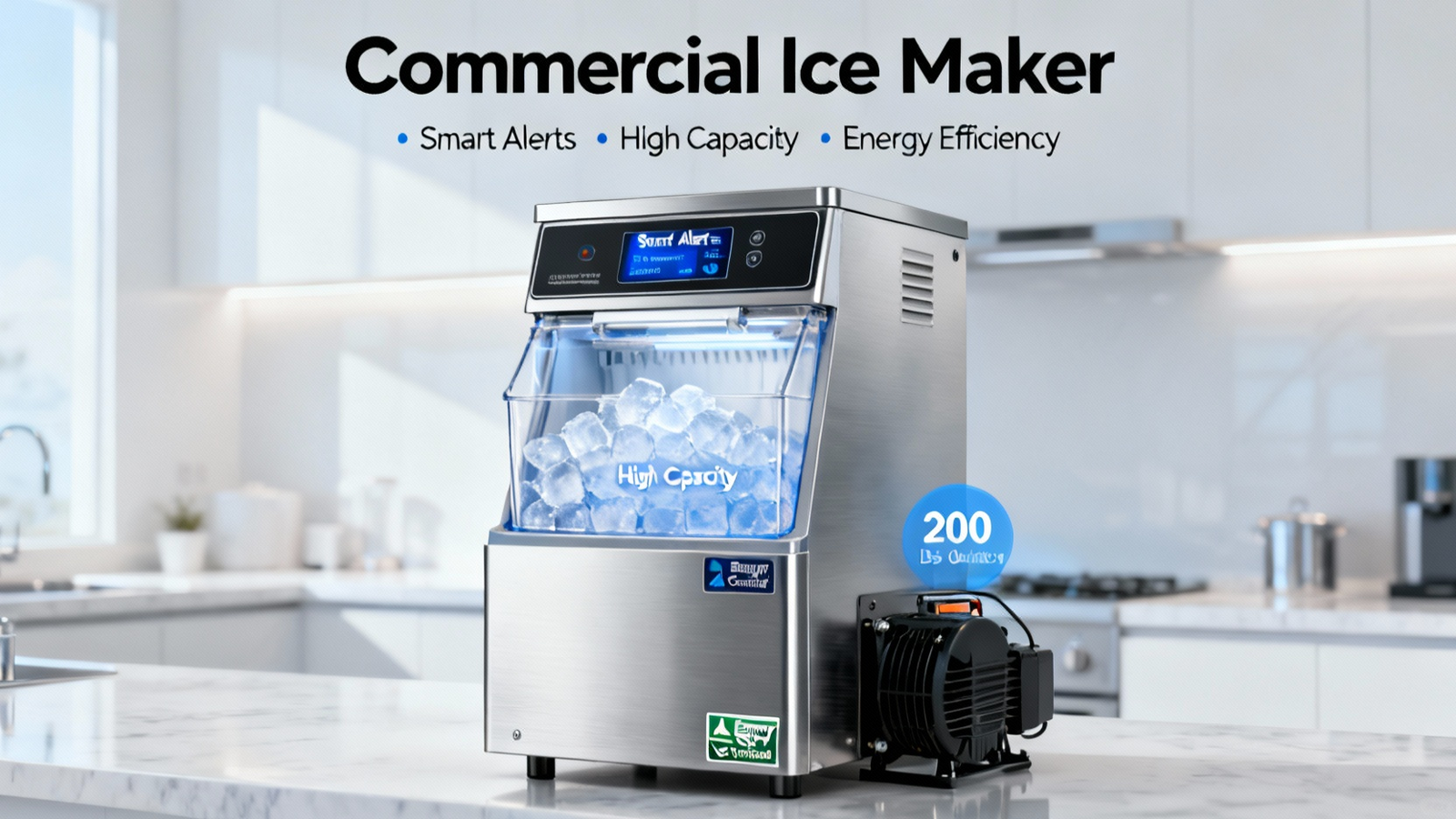
For any business that relies on a steady supply of ice, from bustling restaurants to high-volume event spaces, a commercial ice maker is a critical investment. This article delves into the advanced features of modern commercial ice makers, focusing on how intelligent alerts, automated maintenance, and high-capacity design work together to ensure operational efficiency and uninterrupted service.
Intelligent Operation: Alerts and Automated Maintenance
Modern commercial ice makers are designed for proactive management. Features like fault alerts and water shortage notifications prevent minor issues from halting production, a common pain point noted in industry discussions. As highlighted in a February 2023 Reddit thread from restaurant professionals, unexpected ice machine failure can cripple service. Furthermore, auto-defrost technology eliminates manual labor and maintains peak efficiency by preventing frost buildup, a feature whose importance is underscored by its prevalence in commercial appliance standards. The inclusion of a water filter is crucial, as noted on Wikipedia’s ice machine entry, which states that filtration “reduces minerals and impurities,” directly impacting ice clarity and taste.
Engineered for Stability and High-Volume Output
Consistent, high-volume production is non-negotiable. A unit like the 22.3″ Commercial Split Ice Maker — 420 lbs/24h is engineered for this demand, producing over 14,900 cubes daily. This capacity ensures establishments are prepared for peak periods. Stability is key to consistent performance; 4-adjustable feet allow for perfect leveling on any floor, eliminating wobble that can affect the machine’s internal mechanisms and lead to uneven ice production or premature wear.
User-Centric Design and Hygienic Access
Beyond raw power, thoughtful design enhances daily usability. An intuitive touch control panel simplifies operation for all staff members. The blue-lighted storage bin is both an aesthetic and functional feature, providing a clear visual indicator of ice levels in low-light environments. For hygiene and convenience, a flip-up bin door and included ice scoop offer easy, sanitary access without needing to remove the entire bin lid, a design consideration that streamlines service during busy hours.
Flexible Installation and Reliable Drainage
Commercial kitchens have varied layouts, and a versatile ice maker adapts to them. The distinction between water pump drainage and gravity drainage is critical for installation planning. Pump drainage offers flexibility, allowing the ice maker to be placed farther from a drain line, while gravity drainage is a simpler, direct option. This flexibility, as often discussed in professional forums, is essential for optimizing kitchen workflow and meeting local plumbing codes, ensuring the unit can be integrated seamlessly into existing infrastructure.
In summary, today’s commercial ice makers, such as the high-capacity 22.3″ split system, represent a significant evolution from basic appliances to intelligent, user-focused partners in business operations. They combine proactive smart alerts to prevent downtime, automated features like defrost to reduce labor, and robust construction for relentless output. The emphasis on stable leveling, hygienic access, and flexible drainage options addresses the real-world challenges faced in foodservice environments, as echoed in professional communities. Ultimately, investing in a unit with these comprehensive features is an investment in operational resilience. It ensures that a business is equipped not just to meet daily ice demands, but to do so reliably, cleanly, and efficiently, protecting revenue and reputation by eliminating a single point of failure in service.
The smart alerts on these commercial ice makers sound like a total game-changer for preventing downtime.
\}}
Smart alerts and high capacity sound like a game-changer for keeping our bar running smoothly without any ice emergencies.
\}}