
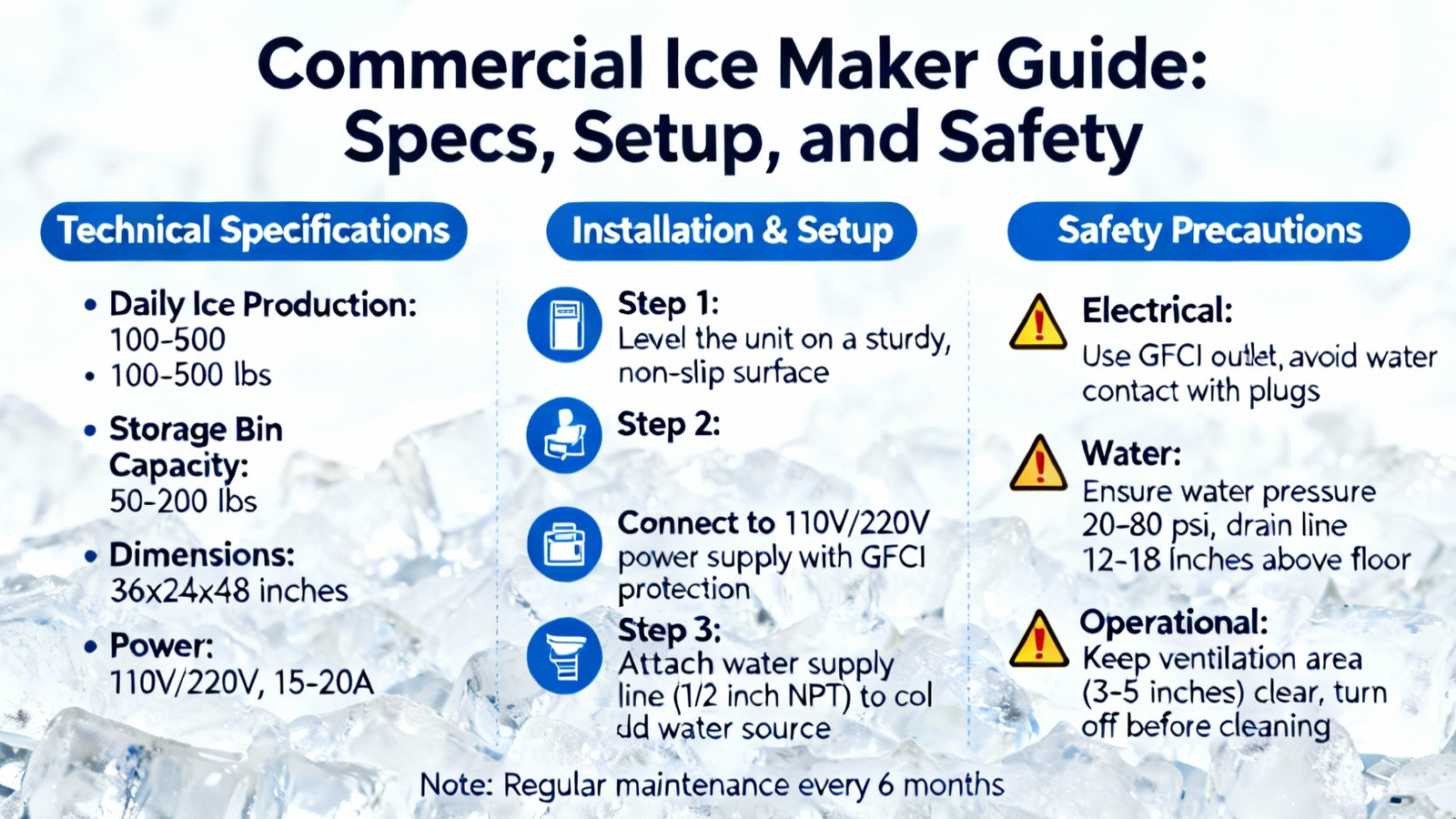
For any bustling foodservice operation, a reliable ice maker is the unsung hero of the back-of-house. This guide delves into the critical specifications, installation requirements, and safety protocols for a heavy-duty commercial ice maker, ensuring you maximize performance and longevity. Understanding these details is key to a seamless integration into your restaurant, bar, or hotel.
Engineering for Endurance: Core Specifications & Build
This unit is engineered for commercial rigor, featuring a fully durable stainless steel construction that resists corrosion and simplifies cleaning—a non-negotiable standard in professional kitchens. Its 110V/60Hz operation and 780W power draw make it compatible with standard US commercial outlets, offering easier installation than high-voltage models. A significant feature is its use of environmentally friendly R290 (propane) refrigerant. According to Wikipedia, R290 has a “negligible ozone depletion potential and very low global warming potential” compared to traditional hydrofluorocarbons, aligning with growing industry sustainability goals. With compatibility for SN, N, and ST climate types, it promises reliable performance across varied environmental conditions common in North America.
Pre-Installation: Space, Placement, and Safety Foundations
Proper setup is critical for safety and efficiency. The unit requires a dedicated drinking water supply line with a pressure between 14.5-58 psi; outside this range, a pressure changeover valve is mandatory to prevent mechanical issues. As highlighted in user discussions on Reddit, such as a February 2023 thread on r/KitchenConfidential, ventilation is paramount. You must maintain at least 5.9 inches (15 cm) of clearance on all sides for adequate airflow, which prevents overheating and ensures efficient operation. Furthermore, the location must be away from direct sunlight, stoves, or radiators, and the power cord must not be near flammable materials. The manufacturer explicitly warns against using extension cords due to the risk of overheating and fire, a point often echoed in electrical safety guidelines.
Critical Setup & Operational Protocols
Upon delivery, the unit must be left upright for 24 hours before initial use to allow the compressor oils to settle, a standard procedure for refrigeration equipment after transport. A gravity-fed drain pipe must be connected before operation, with its outlet lower than the ice maker’s port, to handle meltwater discharge efficiently. It is designed for indoor use only; outdoor operation is not recommended as environmental elements can severely impact the sealed system and electrical components. For consistent ice production, remember that “the surrounding environmental temperature will influence the time of ice making,” meaning output may vary between a cool storeroom and a hot kitchen line.
Long-Term Performance and Maintenance Considerations
To ensure sustained output and hygiene, only use potable water to make ice. Using other liquids can damage the internal evaporator and contaminate the system. The included three-prong plug and 70-inch power cord are designed for grounded safety; never alter this setup. Regular cleaning and descaling, as recommended for all commercial ice makers, are essential to prevent mineral buildup that reduces efficiency and affects ice quality. For operations requiring robust output, exploring models like the 23.2 in. 500 lbs./24h Capacity Commercial Stainless Steel Ice Maker can meet high-volume demands. The durability of a commercial stainless steel ice maker hinges on adhering to these operational and maintenance guidelines.
In summary, integrating a heavy-duty commercial ice maker into your operation requires careful attention to its engineering specs, precise installation, and diligent operational habits. From ensuring the correct water pressure and critical ventilation space to understanding the importance of the 24-hour settling period and proper drainage, each step directly impacts the machine’s reliability and safety. The use of R290 refrigerant reflects a responsible choice for environmental impact, while the stainless steel construction promises lasting durability in a demanding environment. By strictly following the manufacturer’s protocols—such as avoiding extension cords, using only water, and keeping the unit indoors—you protect your investment and ensure a consistent supply of ice. Ultimately, a model built for endurance, like the referenced stainless steel ice maker, when installed and maintained correctly, becomes a dependable asset that supports seamless service and contributes to the overall efficiency and safety of your foodservice business for years to come.
This guide really helped me understand the key specs for choosing a reliable commercial ice maker.
\}}
This guide really helped me understand the key specs for choosing a reliable commercial ice maker.
\}}