
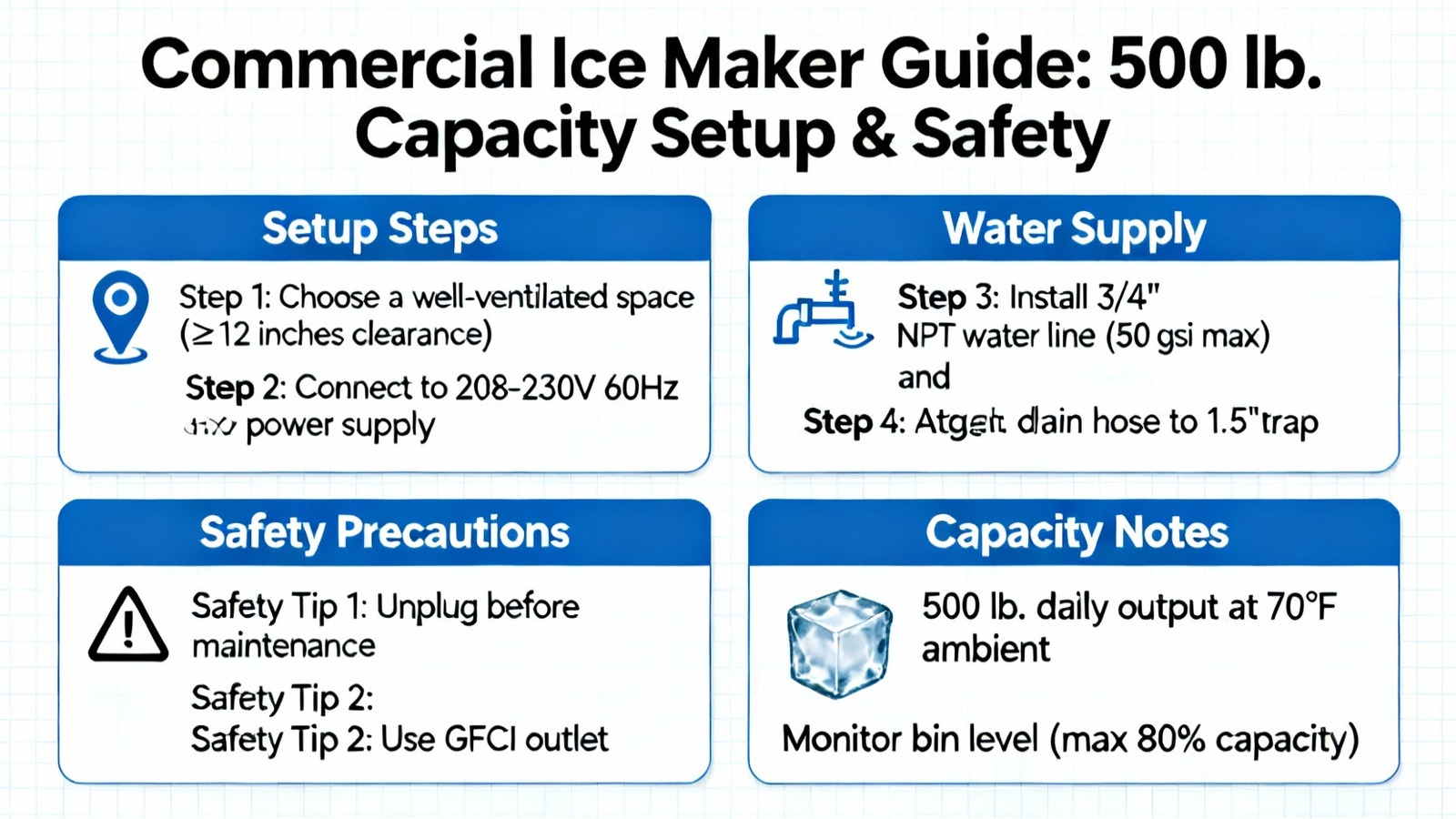
For restaurants, bars, and hotels, a reliable ice maker is a cornerstone of daily operations. This guide delves into the essential features, proper installation, and critical safety protocols for a heavy-duty 500 lb./24h capacity commercial ice maker. Understanding these elements ensures optimal performance, longevity, and safety for your business.
Engineering for Demanding Environments
Built with durable stainless steel construction, this ice maker is designed for the rigors of commercial use. Its compatibility with climate types SN, N, and ST (Subnormal, Normal, and Subtropical) ensures reliable performance across varied environmental conditions, a critical factor for consistent ice production. The unit utilizes environmentally friendly R290 (propane) refrigerant, which has a lower Global Warming Potential (GWP) compared to traditional hydrofluorocarbons (HFCs). As noted in a discussion on sustainable refrigeration, R290 is gaining traction as an eco-conscious choice, though proper handling is essential due to its flammability. The 110V/60Hz operation and 780W power rating make it suitable for standard commercial kitchens in the United States.
Critical Installation and Setup Procedures
Proper installation is non-negotiable for performance and safety. The unit requires a dedicated drinking water supply with a pressure between 14.5-58 psi; outside this range, a changeover valve is mandatory. As emphasized in a Reddit thread from November 2023, improper water line connections are a common source of failure. Furthermore, a gravity-fed drain pipe must be installed with its outlet lower than the machine’s port to handle meltwater. Upon delivery, the unit must remain upright for 24 hours to let the compressor oil settle—a step often highlighted by professionals to prevent immediate damage. Ensure at least 6 inches of clearance on all sides for airflow, and keep the unit away from heat sources and direct sunlight.
Operational Safety and Best Practices
Adhering to safety guidelines protects your investment and your premises. The ice maker comes with a three-prong plug and a 70-inch cord; using an extension cord is strongly discouraged as it can overheat and pose a fire risk. The unit must be kept away from flammable materials. It is designed for indoor use only, as outdoor conditions can adversely affect components and void warranties. Only use potable water to make ice; using other liquids can damage the evaporator and contaminate ice. The Safety Protection Type I classification indicates it is designed for use in environments where basic insulation against electric shock is sufficient, with a grounded supply. For comprehensive electrical standards, references like the Wikipedia entry on Appliance classes provide authoritative context.
Maximizing Longevity and Ice Production
To ensure the 23.2 in. 500 lbs./24h Capacity Commercial Stainless Steel Ice Maker operates at peak efficiency long-term, recognize that ice production time is influenced by ambient temperature. Higher room temperatures will increase cycle times. Regular maintenance, including cleaning the air filter and sanitizing the water distribution system, is crucial to prevent scale and biofilm buildup, which can hinder performance and affect ice quality. The machine’s net weight of approximately 145 lbs. and dimensions of 26.4” W x 23.2” D x 61.4” H necessitate a stable, level location. By following these protocols, you safeguard the machine’s internal components, ensuring it delivers the consistent, high-volume ice output that operations like bars and hotel catering depend on.
In summary, integrating a heavy-duty commercial ice maker into your business requires careful attention to its engineering specifications, meticulous installation, strict safety adherence, and proactive maintenance. From ensuring correct water pressure and drainage to allowing proper settling time and providing adequate ventilation, each step directly impacts the machine’s reliability and output. The use of R290 refrigerant reflects a move toward more sustainable commercial appliances, while the robust stainless steel construction promises durability. By understanding and implementing these guidelines—such as avoiding extension cords and recognizing ambient temperature effects—you transform this powerful appliance into a dependable asset. Ultimately, the success of your commercial ice maker hinges on a commitment to these operational fundamentals, ensuring it meets the relentless demands of your service environment efficiently and safely for years to come.
Great guide on setting up a 500 lb. capacity commercial ice maker—safety and proper installation are so crucial for busy operations.
\}}
This guide is a lifesaver for anyone setting up a 500 lb. capacity commercial ice maker and wanting to get the safety protocols right from the start.
\}}
This guide is a lifesaver for anyone setting up a 500 lb. capacity commercial ice maker and wanting to get the safety protocols right from the start.
\}}