
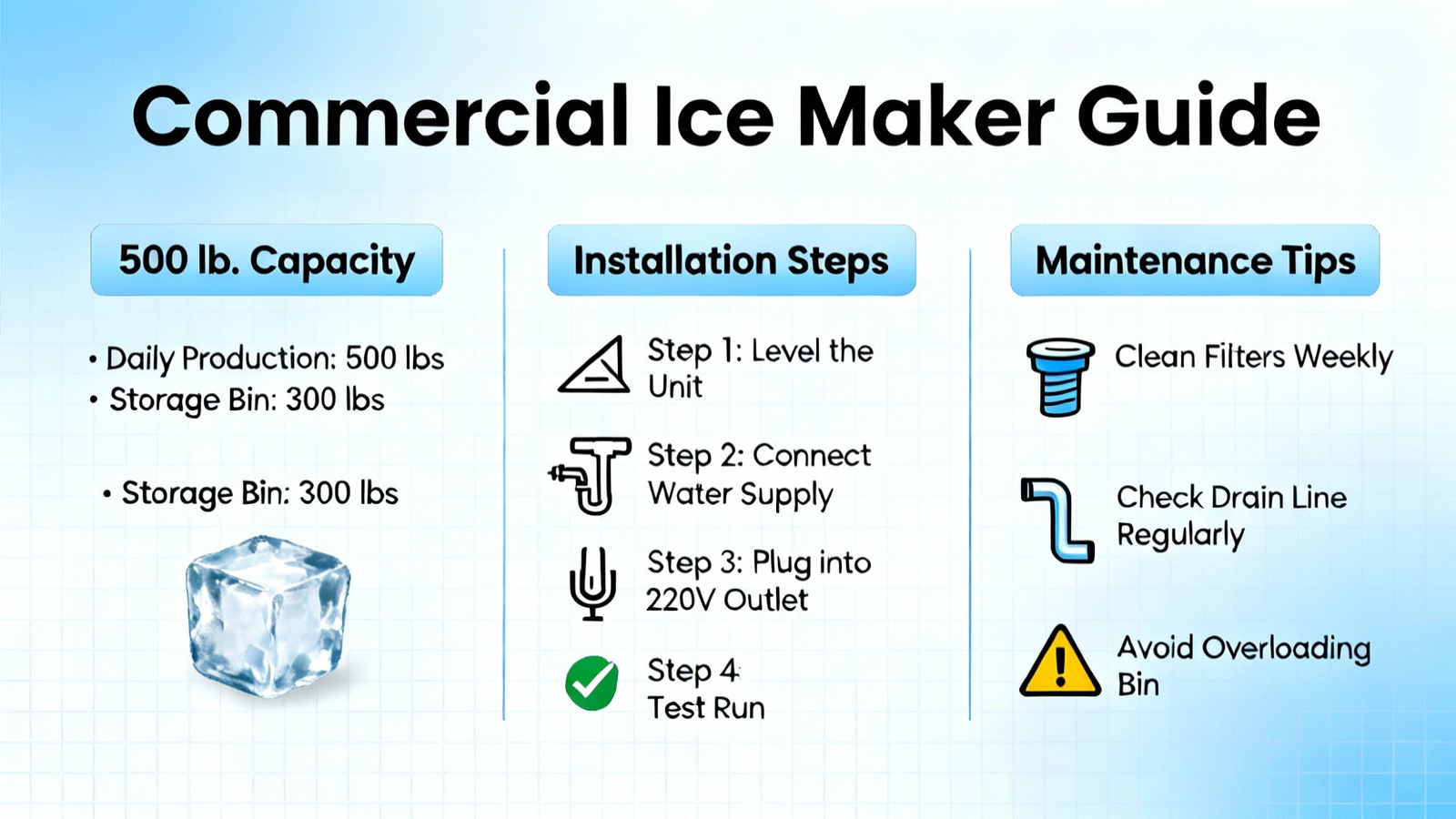
For restaurants, bars, and hotels, a reliable ice maker is essential. This guide explores the key features, installation requirements, and operational best practices for a heavy-duty 500 lb./24h commercial ice maker, ensuring you maximize performance and longevity for your business.
Engineering for Commercial Durability and Efficiency
Built with a stainless steel exterior, this ice maker is designed to withstand the rigors of a high-volume foodservice environment, offering corrosion resistance and easy cleaning. Its operation on standard 110V/60Hz power (780W) makes it versatile for most US commercial kitchens without requiring special electrical upgrades. A significant feature is its use of R290 (propane) refrigerant, an environmentally friendly option with a low Global Warming Potential (GWP). As noted on Wikipedia, hydrocarbons like R290 are “being increasingly used due to their excellent thermodynamic properties and low environmental impact” (List of refrigerants, Wikipedia). Its compatibility with climate types SN, N, and ST ensures reliable ice production across varied temperature environments common in North America.
Critical Installation and Setup Protocols
Proper installation is non-negotiable for safety and performance. The unit requires a direct drinking water supply with a pressure between 14.5 and 58 psi; outside this range, a pressure changeover valve is mandatory. As discussed by professionals on Reddit, improper water pressure is a common cause of ice maker failure (“Ice machine water pressure?”, r/refrigeration, August 2023). Furthermore, a gravity-fed drain line must be installed, with its outlet lower than the machine’s port, to handle constant meltwater discharge. The unit must be positioned with at least 6 inches of clearance on all sides for airflow and must remain upright for 24 hours after delivery before initial use to allow the compressor oil to settle, a critical step often emphasized in appliance manuals.
Operational Safety and Best Practices
Adhering to safety guidelines protects your investment and premises. The included three-prong plug and 70-inch cord should connect directly to a grounded outlet; extension cords are not recommended due to the risk of overheating and fire. The machine must be kept away from heat sources and direct sunlight, and only potable water should be used to make ice—adding other liquids can damage the system and create health hazards. It’s also vital to keep the unit and cord away from flammable materials. For high-capacity needs, consider a model like the 23.2 in. 500 lbs./24h Capacity Commercial Stainless Steel Ice Maker which is engineered for such rigorous demands.
Maximizing Performance and Longevity
To ensure consistent ice production, understand that the surrounding ambient temperature directly influences cycle times; hotter environments can reduce output. Regular maintenance, including cleaning and sanitizing as per manufacturer instructions, is crucial to prevent scale buildup and bacterial growth, topics frequently detailed in industry forums. The self-contained drainage system requires that the drain line remains clear to function properly. Investing in a robust unit, such as the 23.2 in. 500 lbs./24h Capacity Commercial Stainless Steel Ice Maker, provides the durability needed for continuous operation in a commercial setting.
In summary, a commercial ice maker is a significant investment that demands careful attention to specification, installation, and operation. Selecting a unit with durable stainless steel construction, efficient R290 refrigerant, and the correct capacity for your needs sets a strong foundation. Success hinges on meticulous installation—ensuring proper water pressure, drainage, electrical connection, and clearance. Ongoing vigilance regarding safety protocols, like avoiding extension cords and using only water, prevents hazards. Finally, acknowledging that environmental factors affect performance and committing to regular maintenance will maximize the machine’s lifespan and reliability. By understanding and implementing these principles, businesses can ensure their commercial ice maker remains a dependable asset, supporting seamless daily operations and customer service for years to come.
This guide is exactly what I needed to understand the installation requirements for a 500 lb. commercial ice maker.
\}}
This guide is exactly what I needed to understand the installation requirements for a 500 lb. commercial ice maker.
\}}
This guide is super helpful for anyone considering a heavy-duty 500 lb. commercial ice maker for their business.
\}}
This guide is super helpful for anyone considering a heavy-duty 500 lb. commercial ice maker for their business.
\}}
This guide is exactly what I needed to understand the installation requirements for a 500 lb. commercial ice maker.
\}}
This guide is exactly what I needed to understand the installation requirements for a 500 lb. commercial ice maker.
\}}
This guide is exactly what I needed to understand the installation requirements for a 500 lb. commercial ice maker.
\}}
This guide is exactly what I needed to understand the installation and care for a 500 lb. commercial ice maker.
\}}