
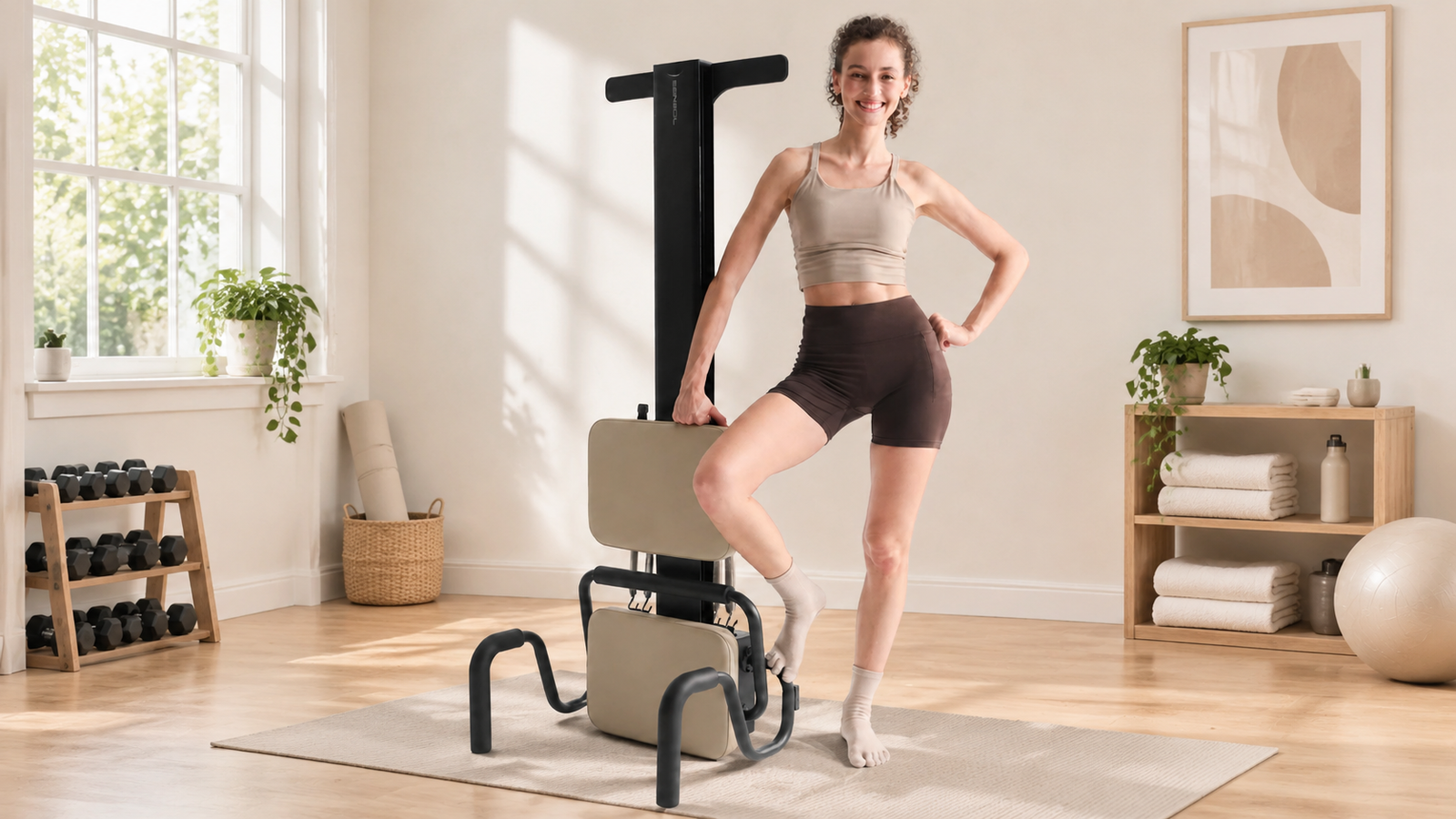
The first-year baseline is $699 before optional costs
The Sensol FLEX AIR is listed at $699 through the official United States store. If you treat that purchase price as the baseline cost for the first year, it works out to about $58.25 per month or $13.44 per week. That calculation does not assume financing, resale value or extra purchases; it simply spreads the listed price across 12 months or 52 weeks.
Is the Sensol FLEX AIR worth it for home use? It can be worth the $699 purchase price when you expect to use a compact spring-resistance reformer regularly and have enough clear workout space. Its value is less convincing if you are unsure about reformer Pilates, need a machine for a user above its stated weight limit, or expect storage to solve every space constraint.
The baseline is relatively easy to understand because the main training equipment is included: the FLEX AIR reformer, two handles and one ankle strap. Four elastic bands are also supplied as a complimentary gift for separate accessory exercises, although they are not the reformer’s main resistance system.
For eligible addresses in the contiguous 48 U.S. states, free standard curbside freight delivery is available, with liftgate unloading included where required. That does not include inside delivery, stair carry, room-of-choice placement or assembly. A serviceable remote mainland address may also incur a carrier surcharge, so those practical delivery details can affect the real first-year total.
Regular use brings the per-session cost down quickly
A home reformer does not become economical merely because it is in the house. The number that matters is cost per completed session. Using the $699 purchase price alone, the FLEX AIR costs about $6.72 per session if used twice a week for 52 weeks, based on 104 sessions.
Three weekly sessions reduce the baseline to about $4.48 each
At three sessions per week, you would complete 156 sessions in one year. Dividing $699 by 156 produces a baseline cost of approximately $4.48 per session. This is often a more useful comparison than the sticker price because it connects the purchase to an actual routine.
Four weekly sessions bring it to about $3.36 each
Four sessions per week would equal 208 sessions over a full year, reducing the purchase-price calculation to roughly $3.36 per session. These figures do not promise that anyone will follow a particular schedule. They show why consistent use is the deciding factor in whether home equipment supports healthy home habits or becomes an expensive object in storage.
Frequency should still be realistic. A planned five-day routine has little financial meaning if you consistently complete only one session. For simple healthy living, a repeatable schedule of shorter, controlled sessions may provide better purchasing logic than an ambitious plan that is difficult to sustain.
A fair comparison must include travel, access and equipment type
Comparing the FLEX AIR with alternatives requires more than placing two advertised prices side by side. Studio Pilates may involve recurring class payments and travel, while a general gym membership may or may not provide reliable access to a reformer. Because no outside price evidence is being used here, the sound approach is to insert your own local figures rather than assume a national average.
Compare it with your real annual studio spending
Start with the cost of one class, multiply it by the number of classes you would genuinely attend in a year, and add any known travel or parking expense. Then compare that result with the $699 FLEX AIR baseline. Studio instruction and home ownership are not identical services, so the calculation should also acknowledge the value you place on coaching and scheduled accountability.
Compare gym access based on availability, not membership alone
A gym can appear less expensive if you already pay for membership, but the relevant question is whether it offers the equipment and access you intend to use. Waiting for a machine, travelling to the facility or finding that reformer sessions require a separate booking can change the comparison. Conversely, a gym may offer broader equipment variety that a single home reformer cannot replace.
Floor-based Pilates is cheaper but not mechanically equivalent
Mat or floor-based exercise can be the lowest-cost option when your priority is movement at home rather than owning a reformer. It should not be described as the same setup, however. The FLEX AIR uses mechanical springs as its main resistance, so a mat-only routine does not reproduce that mechanism.
The best one-year comparison therefore uses two columns: total money spent and the type of access received. The FLEX AIR offers at-home access to a mechanical spring-resistance reformer. Classes offer instruction and dedicated appointments, while basic floor exercise minimizes equipment spending. Your preferred form of wellness at home determines which difference matters most.
The footprint determines whether the $699 purchase gets used
The FLEX AIR measures 64.8 × 24.3 × 17.3 inches when set up, equivalent to 164.5 × 61.6 × 43.9 centimetres, measured length by width by height. Those figures help with basic room planning, but they are not the total workout area. You also need clear space around the reformer for your full range of movement.
Measure the active workout zone rather than the machine alone
A space that fits a 64.8-inch-long frame may still feel restrictive once handles, an ankle strap or extended limbs are involved. Before ordering, mark the listed footprint on the floor and then assess the surrounding clearance required for the movements you plan to perform. This is more reliable than judging the room from a photograph.
Upright storage helps between sessions, not during them
The reformer has an upright storage position intended to help reclaim floor space after training. That is useful in a shared room, but it does not reduce the space needed while exercising. You must also have a suitable place for the reformer in its storage position and follow the supplied setup, storage and safety instructions.
Space planning has a direct effect on cost per use. If furniture must be moved extensively before every session, the extra friction may weaken consistency. A convenient setup supports regular practice; an awkward one can leave the first-year cost divided by far fewer sessions than expected.
Spring resistance and included accessories cover the core setup
The FLEX AIR is a mechanical Pilates reformer, and its main resistance comes from springs. This distinction matters because the four included elastic bands are complimentary accessories for separate exercises. They should not be counted as the reformer’s primary resistance system or treated as a replacement for its springs.
Along with the reformer, the package includes two handles and one ankle strap. SENSOL FLEX workout guidance is also available to help users build a routine. Based on the stated package contents, those components cover the supplied starting setup without requiring an immediate purchase of the same basic accessories.
The maximum stated user weight is 264.6 pounds, or 120 kilograms. That is a firm suitability check rather than a performance target. Anyone above that limit should choose a different product rather than trying to adjust technique or session intensity to compensate.
Optional purchases should remain separate in your budget. If you later decide that you want additional home-training items, add them to your personal first-year total rather than treating them as part of the $699 baseline. This keeps comparisons transparent and prevents a simple purchase-price calculation from being mistaken for every possible ownership expense.
The FLEX AIR is not suitable for every buyer
This reformer is not for a user above the stated 264.6-pound or 120-kilogram maximum. It is also a poor fit for a room that can accommodate the listed dimensions but cannot provide adequate clearance around the machine. Upright storage can return floor area between workouts, yet it cannot make an undersized active training area safe or practical.
It may not suit someone who wants inside delivery, stair carry, room placement or assembly included with standard shipping. The stated free delivery for eligible contiguous U.S. addresses is curbside freight. Customers at remote mainland addresses should also account for the possibility of a logistics-carrier surcharge, while service to a specific Alaska mainland address needs to be verified before ordering.
Beginners who need continuous, in-person correction should not assume that owning equipment replaces professional instruction. The included workout guidance can help structure a routine, but buyers should distinguish guidance from live supervision. Anyone managing an injury or medical limitation should seek appropriate individualized advice before beginning a new exercise program.
Finally, the FLEX AIR is unlikely to be cost-effective for someone who does not enjoy reformer training or cannot commit to regular sessions. Trying Pilates first through suitable instruction may be more sensible than purchasing solely because the one-year per-session calculation looks attractive.
Where to Buy
For United States customers: Sensol FLEX AIR at the official Sensol store — US store.
The best budget decision starts with four practical questions
How often should this be refreshed or maintained?
No fixed maintenance interval is provided in the stated product information, so follow the supplied setup, storage and safety instructions rather than inventing a schedule. Check the reformer and its working area before use, and address visible wear or unusual operation before continuing a session.
What should beginners start with?
Beginners should start with the supplied guidance and controlled movements they can perform consistently. Learn how the mechanical spring resistance, handles and ankle strap are intended to be used before adding separate exercises with the complimentary elastic bands.
What mistakes should I avoid?
Do not confuse the listed machine dimensions with the total space required for training, and do not treat the gift bands as the reformer’s main resistance. Avoid exceeding the 264.6-pound or 120-kilogram user limit, and follow the supplied instructions for setup and upright storage.
How do I choose quality on a budget?
Compare the stated resistance system, included accessories, user limit, setup footprint and delivery terms with how you will actually train. Then divide the full purchase amount by a realistic annual session count; a machine that fits your room and routine is usually a sounder budget choice than one bought on price alone.
Breaking the Sensol FLEX AIR’s $699 first-year cost down to about $58 a month makes it much easier to compare, though I’d be curious how much the optional expenses typically add.