
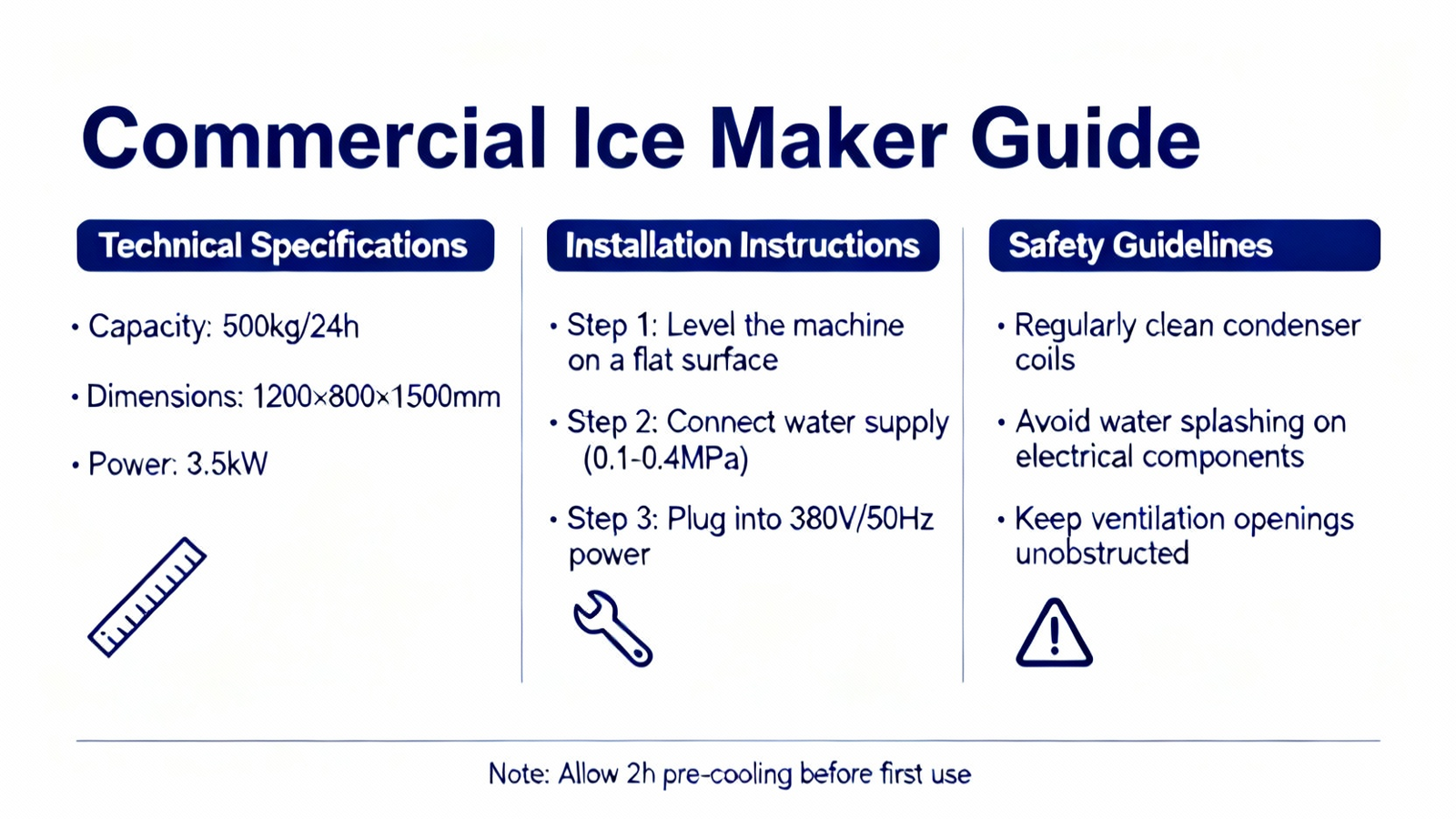
For restaurants, bars, and hotels, a reliable ice maker is a backbone of daily operations. This guide delves into the critical specifications, proper installation, and essential safety protocols for a heavy-duty 500 lb./24h capacity commercial ice maker. Understanding these elements is key to ensuring optimal performance, longevity, and safety in your foodservice business.
Engineering for Commercial Endurance
Built with durable stainless steel construction, this ice maker is designed for the rigors of high-volume use. Its 110V/60Hz operation and 780W power draw make it suitable for standard US commercial kitchens, while the use of environmentally friendly R290 (propane) refrigerant aligns with modern EPA regulations for lower global warming potential. The compatibility with climate types SN, N, and ST ensures reliable performance across varied environmental conditions common in the United States, from constant temperate to subtropical regions. As noted in discussions on commercial equipment, stainless steel is preferred for its “durability and ease of cleaning” in demanding environments like kitchens.
With a substantial net weight of approximately 145.51 lb. and dimensions of 26.4″ x 23.2″ x 61.4″, it’s a sizable piece of equipment designed for stationary, high-output use. This Commercial Stainless Steel Ice Maker is engineered to meet the continuous demand of busy establishments, producing up to 500 pounds of ice every 24 hours.
Critical Installation & Setup Requirements
Proper installation is non-negotiable for performance and safety. The unit requires a direct connection to a drinking water supply with a specific pressure range of 14.5-58 psi; outside this range, a changeover valve is mandatory. A gravity-fed drain pipe, with its outlet lower than the machine’s, must be connected to handle meltwater and discharge. The machine needs a minimum of 5.9 inches of clearance on all sides for airflow and heat dissipation.
Upon delivery, a crucial step is to let the unit stand upright for 24 hours before initial use, allowing the refrigerant and oils to settle after transport—a common requirement for compressor-based appliances to prevent damage. The included 70-inch three-prong plug should be connected to a proper grounded outlet; using an extension cord is strongly discouraged due to overheating and fire risks.
Operational Safety and Best Practices
Adhering to safety guidelines protects both your staff and your investment. The ice maker must be kept away from flammable materials, direct sunlight, and heat sources like stoves or radiators, as excessive ambient heat will significantly impede ice-making efficiency. It is designed for indoor use only; outdoor operation is not recommended due to exposure and temperature control issues.
Only potable water should be used to make ice. Using other liquids can damage the internal components and create unsanitary conditions. Furthermore, as highlighted in a Reddit thread on appliance safety, ensuring a dedicated outlet and proper clearance are among the top “often overlooked” setup steps that prevent future hazards.
Maximizing Performance and Longevity
To ensure the 500 lbs./24h Capacity Commercial Stainless Steel Ice Maker operates at peak efficiency, ongoing attention to its environment is key. The surrounding air temperature directly influences freeze cycles and production times. Regular cleaning and maintenance, as per the manufacturer’s instructions, are essential to prevent scale buildup and sanitary issues. The Safety Protection Type I classification indicates it is designed for environments where protection against electric shock is provided by basic insulation and no grounding of accessible parts is required, underscoring the importance of correct electrical installation. Wikipedia’s entry on commercial ice machines notes that regular descaling and filter changes are critical for maintaining output and ice quality in areas with hard water.
In conclusion, integrating a heavy-duty stainless steel ice maker into your commercial operation is a significant investment in your service capability. Its durable construction, high-capacity output, and environmentally conscious R290 refrigerant make it a modern solution for demanding businesses. However, its reliability is wholly dependent on meticulous attention to the outlined installation prerequisites—from water pressure and drainage to electrical requirements and proper settling time. Strict adherence to safety protocols, such as avoiding extension cords and flammable materials, is paramount for preventing operational hazards. By following these comprehensive guidelines for setup, safety, and maintenance, you can ensure this equipment delivers consistent, reliable performance, supporting the smooth flow of your daily operations and safeguarding your investment for the long term. Ultimately, the machine’s endurance mirrors the care put into its installation and upkeep.
This guide really highlights why understanding the specs and safety of a commercial ice maker is so crucial for smooth operations.
\}}
Great guide on choosing a commercial ice maker—getting those specs and safety right is so important for busy kitchens.
\}}